
Cells within the same tissue are not necessarily identical. Even cells that share the same genome can differ substantially in their gene expression, protein abundance, metabolic activity, regulatory states and responses to environmental signals.
This biological diversity, known as cellular heterogeneity, plays a fundamental role in development, tissue organization, immune responses, cancer progression, neurobiology and disease mechanisms.
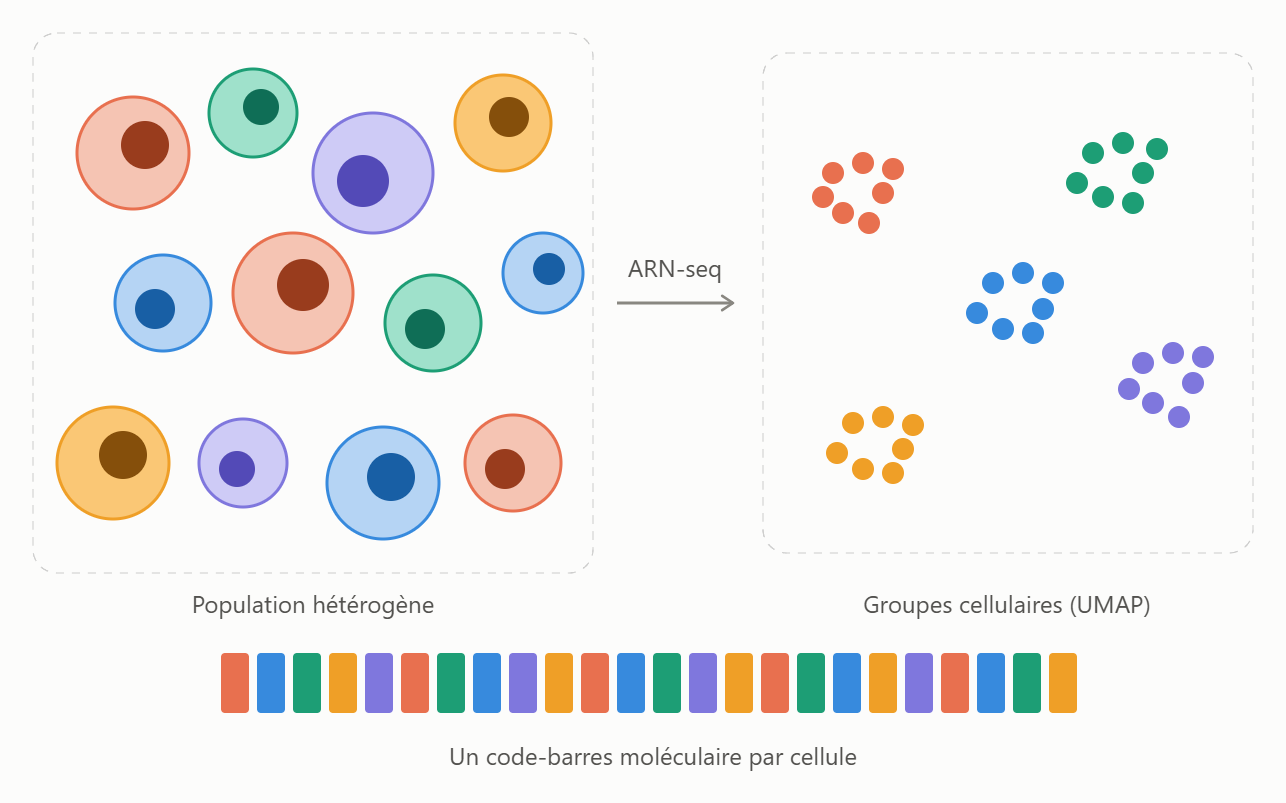
Traditional omics approaches generally analyze populations of thousands or millions of cells simultaneously. The resulting measurements represent an average molecular profile and can therefore mask rare cell populations and distinct cellular states.
Single-cell omics has transformed this perspective by allowing biological processes to be investigated at the resolution of individual cells.
What Is Single-Cell Omics?
Single-cell omics refers to a collection of technologies designed to measure molecular features at the level of individual cells.
Depending on the technology, researchers can investigate:
- Single-cell transcriptomes
- Genomic alterations
- Epigenetic states
- Chromatin accessibility
- Protein expression
- Metabolites
- Cell–cell interactions
- Spatial organization
- Multiple molecular layers simultaneously
Rather than asking what happens in an average population, single-cell approaches can address a more precise question:
What molecular states exist within each individual cell, and how do these states differ across a biological system?
Recent developments have expanded single-cell analysis from transcriptomics toward integrated multi-omics approaches combining genomic, transcriptomic, epigenomic and proteomic information.
Why Cellular Heterogeneity Matters
A tissue may contain multiple cell types, but heterogeneity also exists within the same cell type.
For example, two cells classified as the same neuronal population may express different sets of genes and proteins. Their metabolic activity, signaling pathways and responses to stress can also differ.
Cellular heterogeneity can originate from:
- Genetic variation
- Epigenetic regulation
- Transcriptional fluctuations
- Cell-cycle differences
- Metabolic states
- Microenvironmental signals
- Developmental stage
- Cellular stress
- Cell–cell communication
This heterogeneity is particularly important in complex tissues where multiple cell populations interact.
Single-cell technologies provide a framework for separating these populations and identifying molecular states that would otherwise be hidden within bulk measurements.
A recent systems-level review emphasizes that single-cell technologies are increasingly revealing heterogeneity within apparently homogeneous populations and helping researchers distinguish biological variation from technical variability.
From Bulk Omics to Single-Cell Resolution
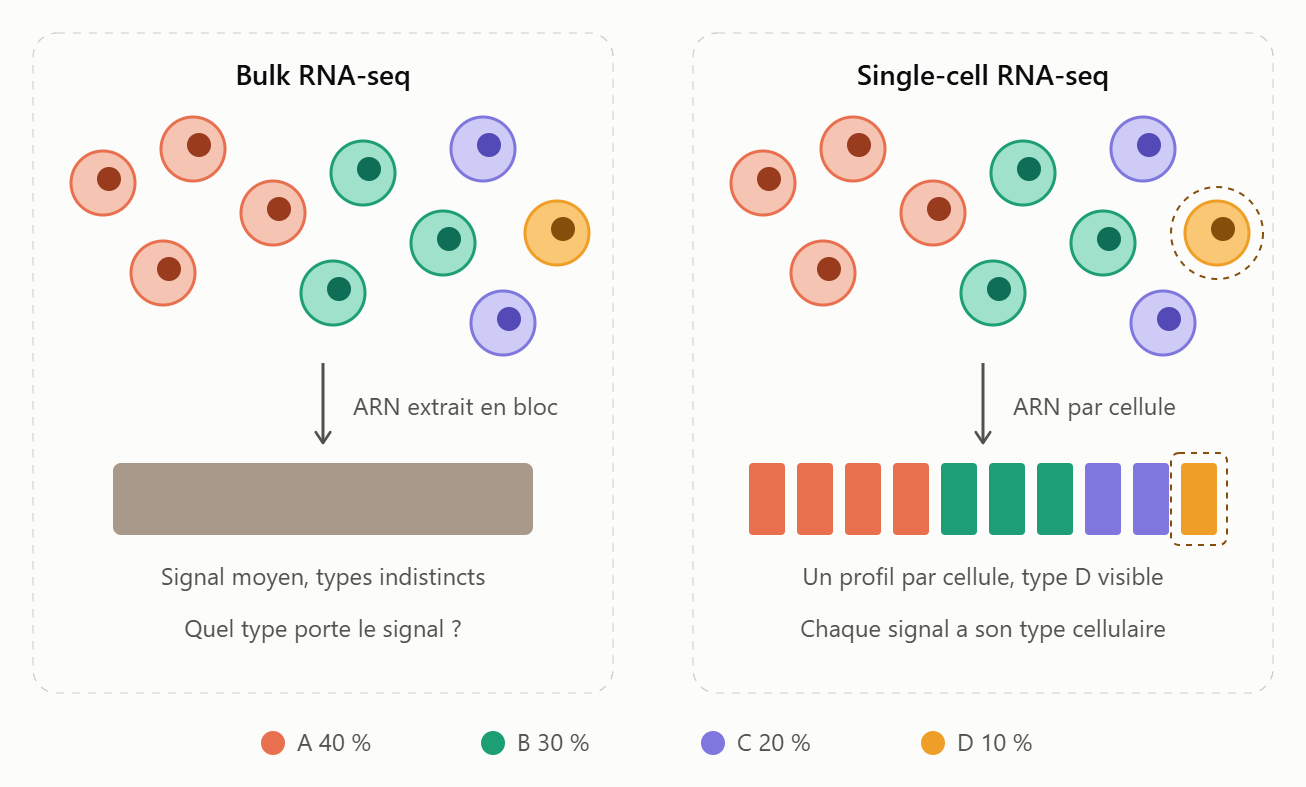
Traditional bulk RNA sequencing measures RNA extracted from a population of cells.
For example, if a tissue contains:
- 40% cell type A
- 30% cell type B
- 20% cell type C
- 10% rare cell type D
bulk sequencing produces an averaged molecular signal across the entire population.
This can make it difficult to determine which cell type is responsible for a particular gene-expression pattern.
Single-cell RNA sequencing changes the analytical strategy by generating molecular profiles for individual cells.
Researchers can therefore:
- Identify different cell populations.
- Characterize gene-expression programs.
- Detect rare populations.
- Compare cellular states.
- Investigate differentiation trajectories.
- Study interactions between cell populations.
This shift from population-level averages to cellular-level measurements has become one of the major developments in modern molecular biology.
Single-Cell RNA Sequencing
Single-cell RNA sequencing (scRNA-seq) is one of the most widely used single-cell technologies.
The general workflow involves isolating individual cells or nuclei, capturing their RNA molecules, converting RNA into sequencing libraries and generating sequencing data for computational analysis.
The resulting dataset can contain thousands or millions of molecular measurements across many individual cells.
Typical analytical steps include:
- Quality control
- Normalization
- Dimensionality reduction
- Clustering
- Cell-type annotation
- Differential expression analysis
- Pathway analysis
- Trajectory inference
- Cell–cell communication analysis
Modern scRNA-seq technologies are also moving toward higher molecular resolution.
Recent developments in full-length single-cell transcriptomics aim to improve the characterization of transcript structures, isoforms, RNA types and other features that may not be fully captured by conventional tag-based approaches.
Single-Cell Proteomics
RNA expression does not always directly correspond to protein abundance.
Proteins are the molecules that perform many cellular functions, making single-cell proteomics an important complementary approach.
Mass-spectrometry-based single-cell proteomics has progressed rapidly through improvements in:
- Sample preparation
- Microfluidics
- Robotic handling
- Peptide separation
- Mass spectrometry
- Multiplexing
- Computational analysis
Recent developments have increased sensitivity and proteome coverage from extremely small protein inputs, while computational approaches are being developed to address missing data and improve reproducibility.
Single-cell proteomics can therefore provide another layer of information about cellular phenotypes.
Single-Cell Epigenomics
Cellular identity is not determined only by gene sequence or RNA expression.
Epigenetic mechanisms regulate which genomic regions are accessible and which genes can be expressed.
Single-cell epigenomic technologies can investigate features such as:
- Chromatin accessibility
- DNA methylation
- Histone modifications
- Regulatory elements
- Transcription-factor activity
When combined with transcriptomic information, these approaches can help connect regulatory mechanisms with gene-expression states.
Multimodal single-cell methods can measure several molecular layers within the same cell, providing a more integrated view of cellular regulation.
Single-Cell Multi-Omics
One of the major directions in current single-cell research is multi-omics integration.
Instead of analyzing one molecular layer independently, researchers can combine several types of information.
For example:
Genome → Epigenome → Transcriptome → Proteome → Phenotype
This integrated perspective can help explain how genetic and regulatory information ultimately contributes to cellular behavior.
Single-cell multi-omics can combine:
- DNA
- RNA
- Chromatin
- Protein
- Epigenetic information
- Metabolic information
The objective is not simply to generate more data, but to connect molecular layers within the same biological context.
Recent reviews describe integrated epigenomic and proteomic approaches as important tools for understanding the regulatory mechanisms underlying cellular heterogeneity.
Spatial Single-Cell Omics
Single-cell sequencing provides detailed molecular information, but tissue dissociation can remove information about where cells were originally located.
This is where spatial omics becomes important.
Spatial transcriptomics and related technologies allow molecular information to be associated with its location within tissue.
Researchers can investigate:
- Where specific cell populations are located
- Which genes are expressed in different tissue regions
- How cells interact with neighboring cells
- How cellular states vary across tissue architecture
- How disease-associated molecular patterns are spatially organized
The combination of single-cell and spatial omics is creating increasingly detailed maps of tissues.
Recent developments are pushing spatial transcriptomics toward microscopic and even subcellular resolution, while creating new computational challenges involving data sparsity, segmentation and cross-platform integration.
Single-Cell Omics in Neuroscience
The nervous system contains a remarkable diversity of neuronal and non-neuronal cell populations.
Single-cell technologies can distinguish molecularly different populations of:
- Neurons
- Astrocytes
- Oligodendrocytes
- Microglia
- Neural progenitor cells
- Endothelial cells
This makes single-cell analysis particularly valuable for studying:
- Brain development
- Neurodegeneration
- Neuroinflammation
- Neuronal differentiation
- Synaptic biology
- Brain aging
Combining single-cell transcriptomics with spatial technologies can further reveal how molecular states are distributed throughout specific brain regions.
Single-Cell Omics and Cell Differentiation
Cells frequently change their molecular states during development and differentiation.
For example:
Stem cell → Progenitor cell → Intermediate state → Specialized cell
Single-cell datasets can capture cells at different stages of these processes.
Computational trajectory-analysis methods can then be used to investigate potential transitions between cellular states.
This provides a dynamic perspective that differs from simply classifying cells according to their final identity.
Single-cell technologies are therefore increasingly used to investigate developmental biology and cellular fate decisions.
Artificial Intelligence and Single-Cell Omics
The increasing size and complexity of single-cell datasets create significant computational challenges.
Artificial intelligence and machine learning are becoming increasingly relevant for:
- Cell-type annotation
- Clustering
- Dimensionality reduction
- Image analysis
- Spatial analysis
- Biomarker discovery
- Multi-omics integration
- Cell-state prediction
Machine-learning approaches can help identify complex patterns that are difficult to detect using conventional statistical approaches.
However, computational predictions still require careful biological interpretation and experimental validation.
The integration of AI with single-cell and spatial omics is currently one of the important directions in computational biology.
From Single-Cell Data to Biological Maps
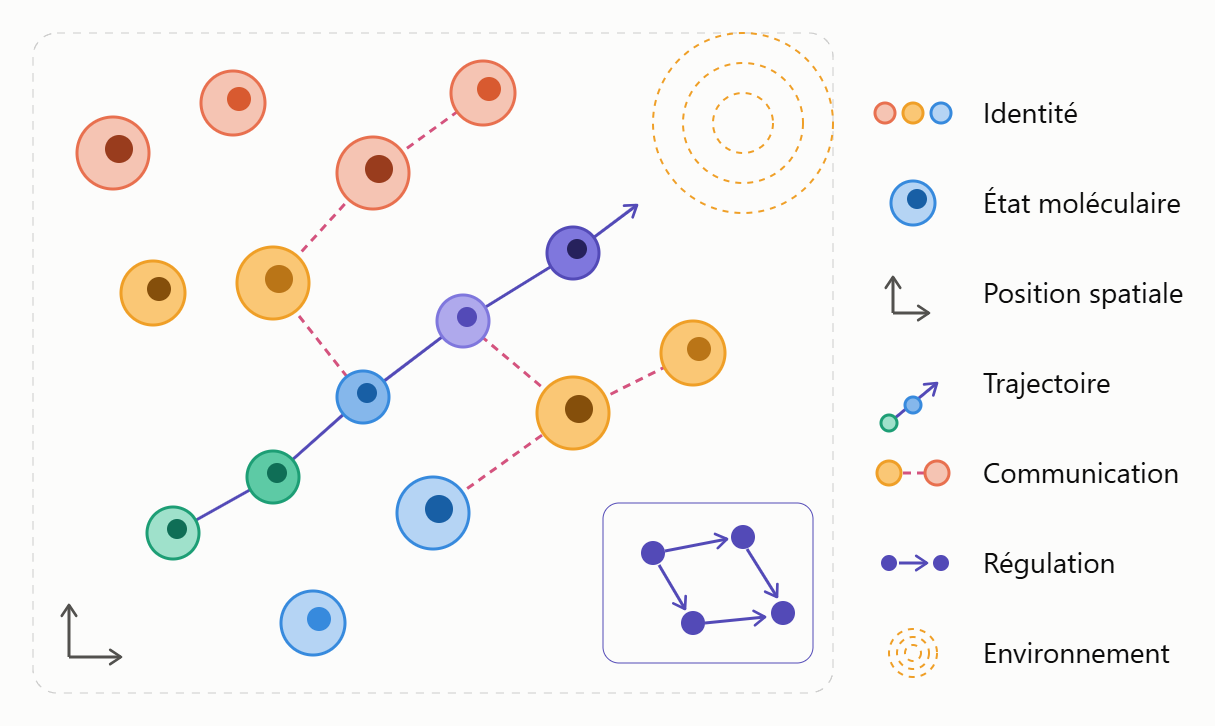
Modern single-cell research is moving beyond the simple identification of cell types.
Researchers increasingly aim to construct multidimensional cellular maps that integrate:
- Cell identity
- Molecular state
- Spatial position
- Developmental trajectory
- Cell–cell communication
- Regulatory mechanisms
- Environmental signals
This creates a more comprehensive representation of biological systems.
Single-cell and spatial technologies are therefore becoming components of increasingly integrated experimental and computational workflows.
Challenges of Single-Cell Omics
Despite rapid technological development, single-cell analysis remains technically and computationally challenging.
Sample Preparation
Cell dissociation can alter cellular states or selectively damage fragile populations.
Technical Noise
Single-cell datasets can contain substantial technical variation and missing measurements.
Data Sparsity
The number of detected molecules can be limited, particularly when measuring low-abundance transcripts or proteins.
Cell-Type Annotation
Assigning biological identities to cells is not always straightforward and can depend on reference datasets and marker selection.
Batch Effects
Experiments performed at different times or using different technologies may introduce systematic differences.
Computational Complexity
Large single-cell datasets require substantial computational resources and specialized analytical workflows.
Multi-Omics Integration
Combining datasets generated by different technologies remains challenging because each modality has different measurement characteristics.
Recent research continues to address these issues through improved experimental protocols, computational models and integrated analysis frameworks.
The Future of Single-Cell Omics
The future of single-cell research is likely to involve increasingly integrated measurements.
Emerging directions include:
Higher-resolution transcriptomics
Improved sequencing technologies are increasing transcript-level resolution and expanding the range of RNA molecules that can be characterized.
Spatial multi-omics
Researchers are increasingly combining spatial information with multiple molecular layers.
Single-cell proteomics
Mass-spectrometry-based approaches continue to improve sensitivity, throughput and proteome coverage.
AI-assisted analysis
Machine learning can support the interpretation of increasingly complex single-cell and spatial datasets.
Three-dimensional molecular mapping
New spatial approaches are moving toward three-dimensional representations of tissue organization.
Single-cell mass spectrometry imaging
Recent advances are enabling increasingly detailed spatial measurements of metabolites, lipids and proteins at cellular resolution, with applications including cancer and neurodegenerative disease research.